Beyond the River Crossing: The Real Story of the Great Migration
The Great Migration is far more than a dramatic river crossing. Discover the extraordinary journey of wildebeest across the Serengeti, shaped by rain, survival and the seasons.
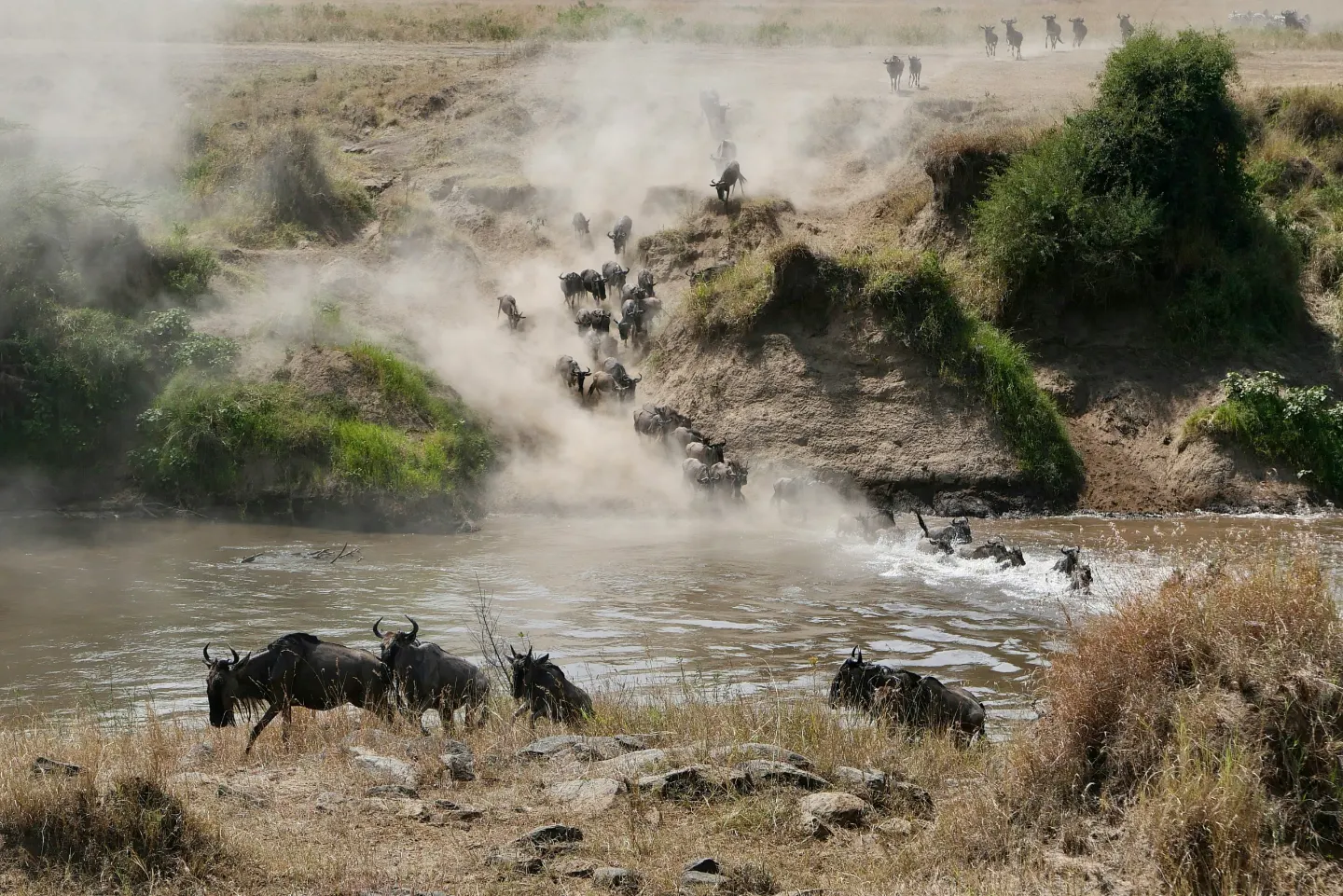
The Great Migration is one of Africa's most celebrated wildlife spectacles. Yet beyond the dramatic river crossings and images of enormous herds lies a far more remarkable story: an endless journey across the Serengeti ecosystem, guided by rainfall, fresh grazing and the instinct to survive.
A Journey That Never Truly Ends
The Serengeti has a way of making the extraordinary appear almost ordinary.
On a wide stretch of grassland, wildebeest may be scattered across the horizon, grazing beneath an immense African sky. Some move steadily through the grass, others pause to rest, and a few stand watchful among the zebras sharing their feeding grounds.
From a distance, the scene appears peaceful. There is little to suggest that these animals are part of one of the greatest movements of wildlife on Earth.
Yet the landscape is constantly changing, and the herds must change with it.
The Great Migration is not a journey towards one final destination. It is an immense seasonal movement through the Serengeti–Mara ecosystem, as wildebeest and other grazing animals respond to rainfall, vegetation and the availability of water.
There is no beginning that can be marked neatly on a calendar, and no finish line waiting at the end.
Instead, the movement continues, season after season, across a landscape that has shaped the lives of these animals for generations.
The Grass That Drives a Migration
It is tempting to imagine that the wildebeest somehow know exactly where they are going. In reality, their movements are closely connected to the changing conditions of the ecosystem.
Rain transforms the plains, producing the fresh grasses on which the herds depend. As grazing becomes less productive in one region, animals begin moving towards areas offering better opportunities to feed.
These movements are not perfectly coordinated. Herds spread across enormous distances, sometimes taking different routes or remaining in particular areas longer than expected.
Rainfall does not arrive on a fixed schedule, and the landscape does not respond identically every year.
This unpredictability is part of what makes the migration so extraordinary. The animals are not following a prescribed route for the benefit of travellers. They are responding to a changing environment in which finding enough food and water is a matter of survival.
The Serengeti's open landscapes make these movements unusually visible, but their underlying cause is found in the complex relationship between climate, grassland and wildlife.
The Southern Plains: A New Generation
One of the migration's most remarkable chapters unfolds on the southern Serengeti plains and the neighbouring Ndutu region.
During the early months of the year, large numbers of wildebeest gather on nutrient-rich short-grass plains. Here, under suitable seasonal conditions, the calving period brings an extraordinary concentration of new life.
For a brief period, thousands of calves may be born each day across the wider ecosystem.
The young must become mobile quickly. Remaining vulnerable on the open plains is dangerous, particularly in an environment where predators are never far away.
Lions, cheetahs, spotted hyenas and other carnivores are part of the same ecological story. Their presence may create dramatic encounters, but these are not separate events from the migration. They are expressions of the predator–prey relationships that sustain the Serengeti's natural balance.
For travellers, the calving season can be deeply memorable. Yet it also reminds us that the wilderness is not governed by the comforting narratives we sometimes attach to it.
Birth, vulnerability, opportunity and loss exist together on the same grassland.
The Long Road North
As seasonal conditions change and grazing becomes less abundant, substantial numbers of animals begin moving away from the southern plains.
Their journey may take them through central parts of the Serengeti, towards the western corridor and eventually into the northern reaches of the ecosystem.
The movement is neither continuous nor uniform. Some animals travel long distances, while others remain scattered across broad areas.
For a safari visitor, the experience can be astonishing even when nothing particularly dramatic is happening.
Imagine travelling across an open plain and discovering a moving procession of wildebeest extending far beyond the limits of your view. Dust rises beneath their hooves. Zebras feed among them, and the low calls of the herds carry across the grass.
There may be no river crossing, no pursuit by lions and no moment that resembles a television documentary.
And yet the sight of so many animals moving through their ancestral landscape can be every bit as powerful.
The scale of the migration is its own spectacle.
The Drama of the River Crossings
Of all the events associated with the Great Migration, the crossings of the Mara River are perhaps the most famous.
During periods when migrating herds occupy the northern Serengeti and adjoining Maasai Mara ecosystem, animals may gather near the river, sometimes waiting for extended periods before attempting to cross.
The reasons for the hesitation are understandable. Steep banks, strong currents, crocodiles and the confusion of large moving herds create serious dangers.
Some animals enter the water, while others turn away. A crossing may begin suddenly or fail to happen despite hours of apparent anticipation.
Even when a crossing occurs, the experience is rarely orderly.
The scenes can be dramatic and, at times, distressing. Animals may struggle in the current, become separated or encounter predators. For the wildebeest, there is no spectacle. There is only the immediate challenge of reaching the opposite bank.
Responsible safari guides understand this distinction. They observe from permitted locations, avoid obstructing animal movements and do not attempt to manufacture encounters.
For travellers fortunate enough to witness a crossing, the memory can be extraordinary. But the event should be appreciated as a natural occurrence, not something that an operator can promise to deliver on demand.
What the Photographs Cannot Show
Images of the migration often concentrate on its most dramatic moments: a river filled with wildebeest, a predator racing across open ground or an immense herd disappearing into the distance.
These photographs capture something real, but they reveal only a fraction of the experience.
They cannot easily convey the hours of quiet observation that may precede a crossing, the changing quality of the light over the plains or the constant movement of smaller groups between larger herds.
Nor do they communicate the significance of the landscape itself.
The Serengeti's rivers, grasslands and seasonal patterns provide the conditions that allow the migration to continue. Without those ecological relationships, there would be no extraordinary procession of animals to photograph.
That is why the conservation of the wider ecosystem matters so profoundly. The migration depends not only on protecting the animals, but also on maintaining the habitats and movement routes on which they rely.
A safari that helps travellers understand these relationships offers something deeper than a collection of impressive sightings.
Seeing the Migration Responsibly
The Great Migration attracts travellers from around the world, particularly to the areas associated with river crossings and the calving season.
This popularity creates genuine challenges for wildlife management and responsible tourism.
When vehicles crowd an important movement route, the experience can become stressful for the animals and less rewarding for visitors. Pressure to obtain the perfect photograph can encourage behaviour that places wildlife encounters above the wellbeing of the ecosystem.
Choosing an operator with experienced guides and a responsible approach is therefore especially important.
A good guide knows when to approach, when to remain still and when to move away. They understand that wildlife viewing should never interfere with an animal's ability to feed, rest, travel or escape danger.
Travellers can contribute by accepting that some encounters will be distant, some will be brief and others simply will not happen.
The wilderness owes us no particular performance.
The Experience Beyond the Crossing
For those planning a Serengeti safari, the most valuable approach is to appreciate the migration as a seasonal ecological journey rather than a single event.
Calving season on the southern plains offers a different experience from the great herds moving through the western corridor or the tense anticipation of a northern river crossing.
Each chapter reveals something about the landscape and the animals that inhabit it.
And even when the largest herds are elsewhere, the Serengeti remains alive with resident wildlife, from lions resting among rocky outcrops to giraffes moving quietly through the woodland.
Some of the finest safari memories are made when expectations give way to observation.
The migration may have drawn you to the Serengeti, but it is often the smaller and less predictable moments that leave the deepest impression.
Planning Your Serengeti Safari
The location of the migration varies through the year, and choosing the right area is one of the most important parts of planning your journey.
For practical guidance on seasonal wildlife movements, the different regions of the park, accommodation and suggested itineraries, explore our Complete Guide to Serengeti National Park, Tanzania.
The Serengeti is more than a destination for extraordinary wildlife photographs. It is a living landscape shaped by movement, adaptation and the changing seasons.
To witness even a small part of that story is a privilege.
And perhaps that is the real wonder of the Great Migration: not that it produces moments of such extraordinary drama, but that the journey continues long after the safari vehicles have returned to camp.